I’ve recently found the time to revisit a passion project. The app has a number of moving parts and I was struggling to distill it down to an elevator pitch. I’m not actually pitching anything to anyone, but it seemed like a worthwhile exercise to try to summarize this thing that I’m building in a way that someone who doesn’t care how it works would understand.
I got started by using claude and the brainstorming skill that the superpowers plugin provides. That allowed me to get a clear definition of the problem I was trying to solve, an honest list of what the app currently does and a succinct summary of what makes it unique. Armed with this knowledge, I was already better able to describe the problem that I was solving and the solution which I was providing. Then I stumbled across a blog post that Anil Dash had just published. In it he describes a framework for thinking about the things you communicate, so that when you do share a message it becomes something that other people can repeat accurately and without difficulty. To quote the premise:
They have to be able to talk about us without us. What this phrase means, in its simplest form, is that you have to tell a story so clear, so concise, so memorable and evocative that people can repeat it for you even after you’ve left the room. And the people who hear it need to be able to do this the first time they hear the story. Whether it’s the idea behind a new product, the core promise of a political campaign, or the basic takeaway from a persuasive essay (guess what the point of this one is!) — not only do you have to explain your idea and make your case, you have to be teaching your listener how to do the same thing for themselves.
— Anil Dash, They have to be able to talk about us without us

“Microphone” by drestwn is licensed under CC BY 2.0.
This sounded like what I was trying to do, but it’s even more ambitious in its scope. I liked it. A lot. I wanted to try it out, but since I’m lazy, I wanted to see if I could use AI to help. Using the skill creation skill that superpowers provides, it took just a few minutes to turn a blog post into a reusable skill. I simply told Claude where to find the post and it did the rest. I tried the skill, loved the result, and I was off to the races. After test driving the skill on my passion project, I reached out to Anil to see if it was ok to (ab)use his content in this way. He graciously consented.
After trying the skill out for a few other things, I realized that packaging it as a plugin would make for the most convenient way for others to try it out as well. I asked Claude to create a plugin from the skill and that also took just a few minutes. You can find the plugin at https://github.com/oalders/talk-about-us. For a quick start, if you have claude installed, enter:
claude plugin marketplace add oalders/talk-about-us &&
claude plugin install talk-about-us@talk-about-us
(The repository contains a “skill” which is not specific to Claude. Check the README for instructions on how to use this with other AI clients).
This new skill will then be available to audit your content based on the principles in Anil’s post. Enough talk. Let’s see it in action. We are going to demonstrate this skill by seeing if one of my other passion projects, PrettyGoodPing, is doing a good job of communicating to the world what it does. I give you exhibit A. We’ll start with a screenshot of the site because (spoiler alert), the audit came back with so many issues that I’m going to need to rework the front page. I’ll show you the before:
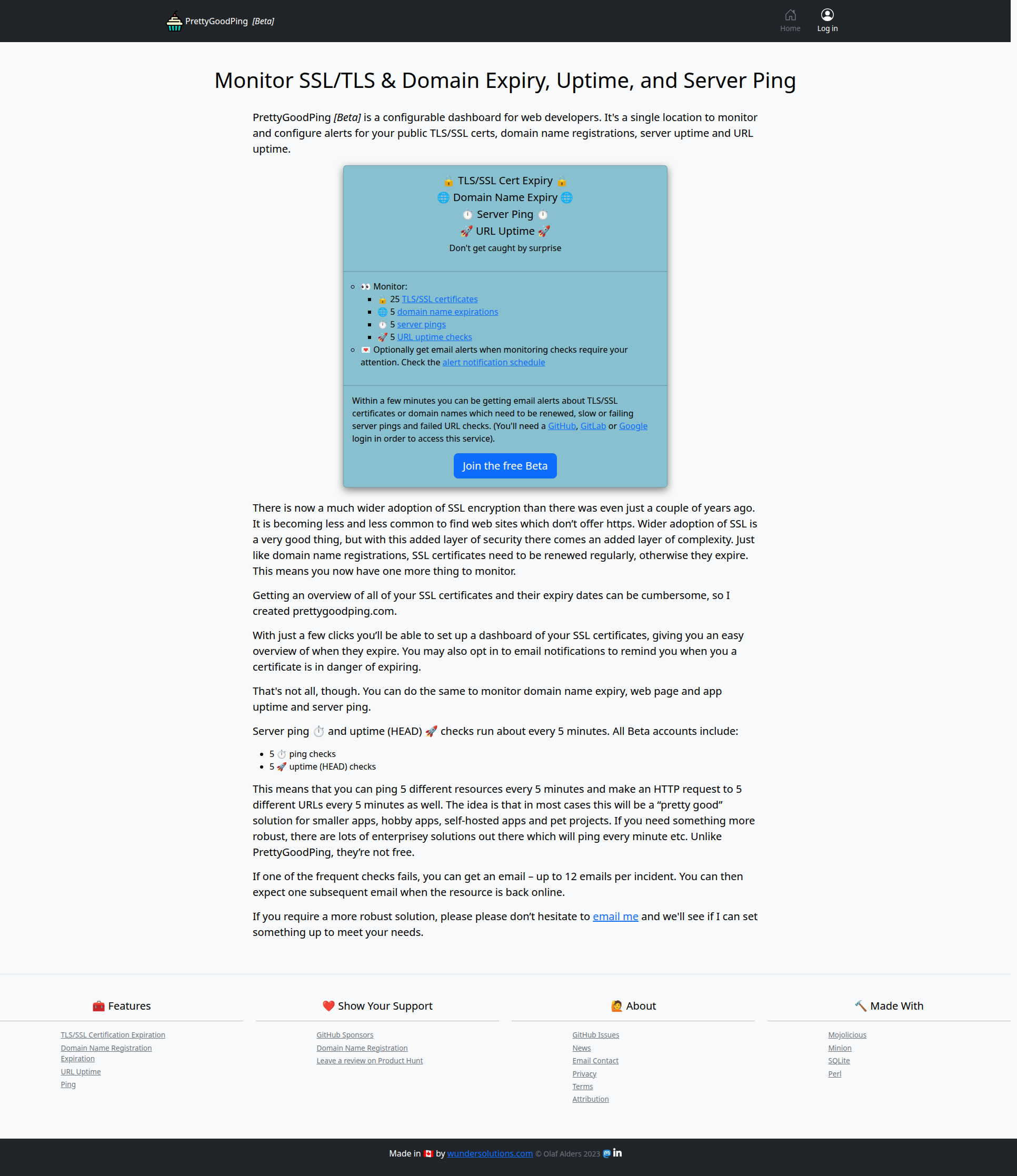
If you want to try this at home, paste the following into Claude Code after you have installed the plugin:
Use the talk about us test to audit the content on the front page of https://www.prettygoodping.com/You may see something like the following:
Content Summary
The front page presents PrettyGoodPing as a monitoring dashboard for web developers, focusing on SSL/TLS certificates, domain expiry, server ping, and uptime checks. The messaging is technical and feature-focused.
❌ 1. The Absence Test: FAIL
“Can someone authentically explain this when I’m not there?”
Current messaging:
- “Monitor SSL/TLS & Domain Expiry, Uptime, and Server Ping”
- “PrettyGoodPing [Beta] is a configurable dashboard for web developers”
Issues:
- Heavy jargon: “TLS/SSL,” “domain registrations,” “server uptime,” “URL availability”
- No one would naturally say this when recommending the service
- Requires technical knowledge to understand what’s being offered
- Very formal, not conversational
What someone might actually say: “It’s a tool that watches your website stuff and emails you before things break” - but the current copy doesn’t enable this kind of natural explanation.
❌ 2. The Distinctiveness Test: FAIL
“Does this say what only WE can say?”
Generic phrases that any competitor could use:
- “configurable dashboard for web developers”
- The feature list (SSL, domain, ping, uptime) is standard for monitoring tools
- “optional email alerts” - not distinctive
What IS distinctive:
- The name “PrettyGoodPing” has personality (modest, unpretentious)
- Specific limits (25 certs, 5 domains) are concrete
- “Built with Perl” goes against the grain
Problem: The distinctive personality suggested by the name isn’t carried into the copy. The messaging could belong to any monitoring service.
❌ 3. The Emotional Resonance Test: FAIL
“Is this emotionally gripping or comprehensively technical?”
Current approach: Comprehensively technical
- Lists features and limits without explaining why you should care
- No connection to the pain point (expired certs breaking your site, surprise downtime)
- No emotional benefit (peace of mind, sleeping soundly, avoiding embarrassment)
- Missing the “what problem does this solve” narrative
Missed opportunities:
- The anxiety of discovering an expired SSL cert at 3am
- The relief of proactive monitoring
- The embarrassment of users seeing security warnings
- The simplicity of “set it and forget it”
❌ 4. The Values-First Test: FAIL
“Are values embedded in how people naturally discuss this?”
The name suggests values: “Pretty Good” implies modesty, pragmatism, honesty (not overpromising “amazing” or “ultimate” monitoring)
The copy suggests different values: Technical precision, comprehensiveness, feature completeness
Disconnect: The personality and values aren’t woven into the language. There’s an opportunity to embrace the “pretty good” ethos - reliable, unpretentious, does what it says on the tin.
Recommendations
Lead with the problem/emotion, not features
❌ “Monitor SSL/TLS & Domain Expiry, Uptime, and Server Ping”
✅ “Never wake up to an expired SSL certificate again”
✅ “Your sites are being watched, so you can sleep”
Use natural, shareable language
❌ “configurable dashboard for web developers focused on monitoring TLS/SSL certificates”
✅ “A pretty good way to know when your website stuff is about to expire”
✅ “We’ll email you before your SSL certs, domains, or servers go sideways”
Embrace the personality from your name
The “PrettyGoodPing” name is brilliant - modest, honest, approachable. Carry that through:
- “We’re not fancy, but we’re reliable”
- “Does what it says, and does it pretty well”
- “Simple monitoring that actually works”
Make it repeatable
Test: Can someone explain this at a meetup without sounding robotic?
❌ Current: “It’s a configurable dashboard for monitoring TLS/SSL certificates, domain registrations, server uptime, and URL availability”
✅ Better: “It watches your SSL certificates and domains, and emails you before they expire. Pretty straightforward.”
Show concrete value, not just features
Instead of listing emoji-decorated features, try:
- “25 SSL certificates watched 24/7”
- “Email alerts 10 days before disaster strikes”
- “Because finding out your cert expired from an angry user email is the worst”
Specific Rewrite Suggestions
Hero Section (current):
“Monitor SSL/TLS & Domain Expiry, Uptime, and Server Ping” “PrettyGoodPing [Beta] is a configurable dashboard for web developers”
Hero Section (suggested):
“Sleep better knowing your sites are being watched” “We monitor your SSL certificates, domains, and uptime - and email you before things break. It’s pretty good at it.”
Feature Section (current):
🔒 TLS/SSL Cert Expiry
🌐 Domain Name Expiry
Feature Section (suggested):
🔒 Never miss an SSL renewal - We’ll bug you 10 days before it expires
🌐 Your domain won’t disappear - 3 weeks warning before expiry
Summary Score: 0/4 Tests Passed
The content is technically accurate but fails all four shareability tests. It’s jargon-heavy, generic, emotionally flat, and doesn’t embody the personality suggested by the excellent brand name.
Key insight: You have a distinctive, personable name (“PrettyGoodPing”) but corporate, generic copy. Let the personality shine through in the messaging.
I never considered my content to be corporate or generic, but here we are. I love that the skill pulls no punches. It reminds me of my first time attending my local masters swim club. The coach told me two things.
- “Your stroke is killing me”
- “Your stroke is a recipe for shoulder pain”
When I heard this feedback, I instantly knew I was at the right place. I wanted to become a better swimmer rather than swimming in compliments. My thoughts on the skill results are similar. What I need is an honest assessment rather than cheerleading.
(As an aside, the coach was correct and I have the scans of my rotator cuff to prove it.)
Now that I have feedback from the skill, I can work to address it. It’s tempting to have Claude do the work and pat yourself on the back, but I think you are going to get the best results with a collaborative approach. Allow Claude to point out the problems and make some suggestions. Then take the suggestions and make them your own. In my own work with this skill, I have taken the feedback to heart but also taken pains to update my content using my own words. I can still ask Claude to evaluate the new content, but the words I use will be my own. If I’m trying to say what truly only I can say, then it kind of makes sense for me to be the one to say it. Also, I write because it brings me joy. I’m not going to ask Claude to write my blog posts in the same way that I won’t ask it to solve my daily New York Times puzzles. I use AI to do the boring stuff, so that I can enjoy the good stuff.