The United States Is Not America
Table of Contents
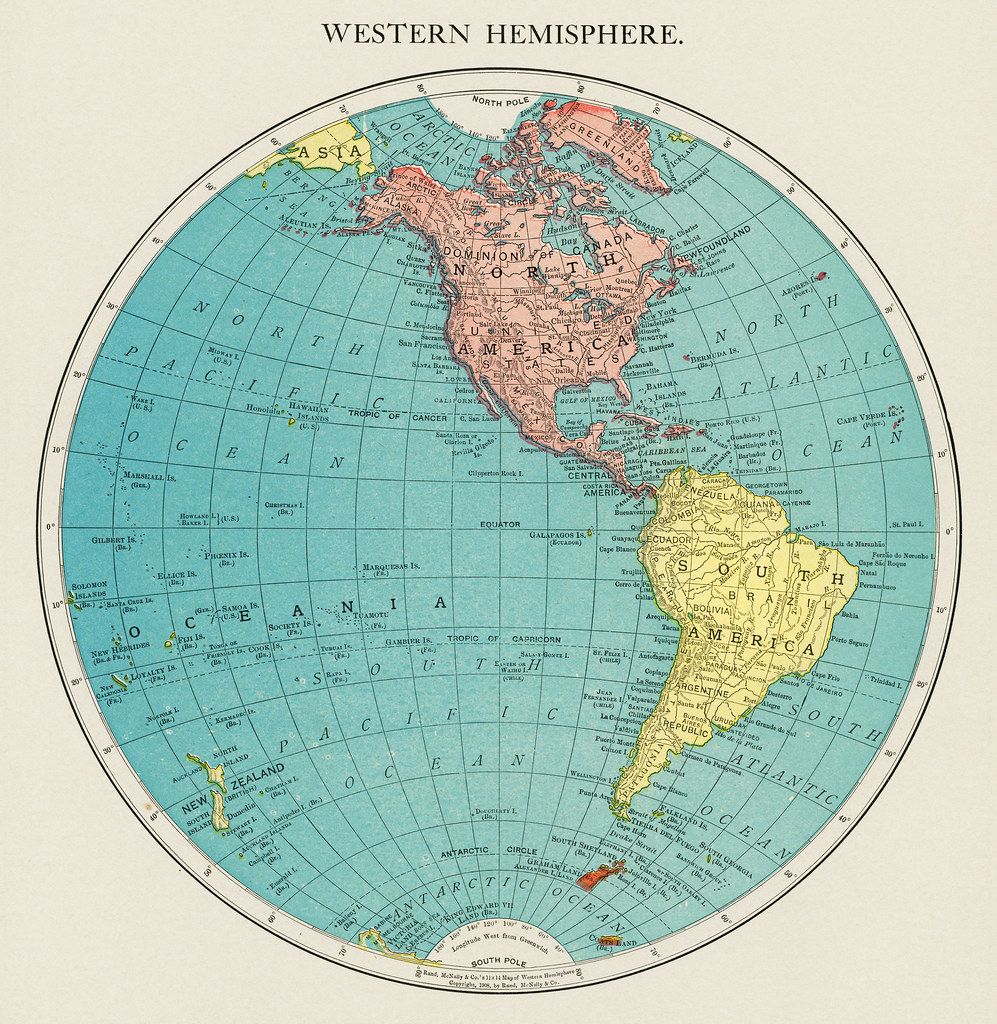
"Western Hemisphere, World Atlas by Rand, McNally and Co. (1908)" by Free Public Domain Illustrations by rawpixel is licensed under CC BY 4.0.
A few years ago I read through the Google developer documentation style guide and found it to be quite helpful. One bit that stood out was that you can refer to plugs and sockets rather than male and female connectors. Even when I was a kid going to Radio Shack that terminology felt a bit weird. It turns out the words we needed were right there.
One surprising bit that I found was the guidance around the use of the word American:
America, American
Use only to refer to the Americas or the American continent.
Don’t use to refer to the United States. Instead, use a more precise term like the US or the United States, and people in the US.
I just checked and, as of this writing, that guidance is still in the document. That was surprising to me as I had just assumed that the America advice had been purged from the style guide some time after the Biden administration came to a close. I’d like to think this remains for good faith reasons, but perhaps the purge is not fully complete. We shall see.
While I recently wrote about the renaming of Lake Ontario and how silly it is, I didn’t touch on perhaps one of the greatest conceits which this manoeuvre betrays – that one country out of all the nations in the Americas has co-opted the name that belongs collectively to all of them.
I think Alana Casanova-Burgess, writing in the Guardian, puts this much more eloquently than I can:
The term “American”…. applies to every country in the hemisphere, and yet one nation, the US, has long claimed a monopoly on its use….
I admit that it can feel tedious to push back on the arrogance of using “American” only to describe the US. Who wants to be the wet blanket in a US newsroom who reminds everyone that America is an entire hemisphere?
#Not In My House
In my own case, I started small, a few years ago by purging, within the confines of my own home, the use of the word American to describe a person, place or thing that originates in the US. I did get some pushback initially, but people are careful with their phrasing around me at home. (I know, I’m a real blast to be around at parties).
#Come On, Carney
And while I generally think Mark Carney is the right leader at the right time here in Canada, I do get disappointed to hear him use the word America to describe the US, as when he said:
Our government understood, before many, that America would transform all its commercial relationships. That it would put a series of tariffs on its closest allies and use economic integration as a weapon. That its signature was written in pencil.
Don’t get me wrong, it’s a memorable line and there’s no arguing with it, but you could express it without using the word America and the point would still stand.
#What About the Rest of the Hemisphere?
We are now at a point where we have allowed the loudest voice in the room to dictate the terms – to tell us we cannot use a word which belongs to all of us, unless it’s accompanied by a qualifier. I cannot call myself American – it’ll have to be North American. Likewise for the qualifiers Central and South.
When we use the word America to describe one country or one people we are passively propping up this thievery of language. Something has been taken from us and many of us don’t realise that we can take it back.
So when an administration starts renaming Gulfs and Lakes with the word America, they’re not just sticking a finger in one of our eyes – it’s both. The first insult is to say “we want to take away a name that the world uses to refer to our shared geography” and the second is “we’re replacing it with a word that we already took from you long, long ago”.
As long as we’re talking about names, maybe the world could follow Google’s style guide and stop reserving the use of America/American for just one nation in the Americas.
In the words of the immortal Bad Bunny:
God Bless America. Chile, Argentina, Uruguay, Paraguay, Bolivia, Peru, Ecuador, Brazil, Colombia, Venezuela, Guyana, Panama, Costa Rica, Nicaragua, Honduras, El Salvador, Guatemala, Mexico, Cuba, Dominican Republic, Jamaica, Haiti, United States, Canada.
Related posts: